Creative Biolabs is offering the most comprehensive services for antibody development projects. With strict regulation and effective execution, we are dedicated to providing the most valuable solutions to complete your projects.
HighlightsCreative Biolabs is offering the most comprehensive services for antibody development projects. With strict regulation and effective execution, we are dedicated to providing the most valuable solutions to complete your projects.
HighlightsCreative Biolabs has established a broad range of platforms for developing novel antibodies or equivalents. These cutting-edge technologies enable our scientists to meet your demands from different aspects and tailor the most appropriate solution that contributes to the success of your projects.
HighlightsWith deep understanding in antibody-related realms and extensive project experience, Creative Biolabs offers a variety of references to help you learn more about our capacities and achievements, including infographic, flyer, case study, peer-reviewed publications, and all kinds of knowledge that can assist your projects. You are also welcome to contact us directly for more specific solutions.
HighlightsGet a real taste of Creative Biolabs, one of the most professional custom service providers in the world. We are committed to providing highly customized comprehensive solutions with the best quality to advance your projects.
HighlightsWhile studies using purified proteins provide valuable data, they often miss the physiological context of the cellular environment. Post-translational modifications, allosteric regulators, and competing binding partners within a cell can significantly alter molecular interactions. To bridge this gap, Creative Biolabs offers state-of-the-art Cell Lysate Affinity Measurement services, enabling the quantitative analysis of binding events in a complex, "native-like" biological milieu. Our advanced platforms allow researchers to measure binding affinity and kinetics directly in crude or partially purified cell lysates, providing more biologically relevant insights into drug-target engagement, protein-protein interactions (PPIs), and signaling pathways. By circumventing the often challenging and time-consuming process of protein purification, our services accelerate research timelines while delivering high-quality, actionable data.
Traditional affinity measurement techniques, such as Surface Plasmon Resonance (SPR) or Bio-Layer Interferometry (BLI), typically rely on highly purified interactants. However, purifying a target protein can be a significant bottleneck. Some proteins are unstable outside their native environment, are expressed at low levels, or require specific chaperones or modifications that are lost upon purification.
Performing Affinity Measurement directly in cell lysates offers several distinct advantages:
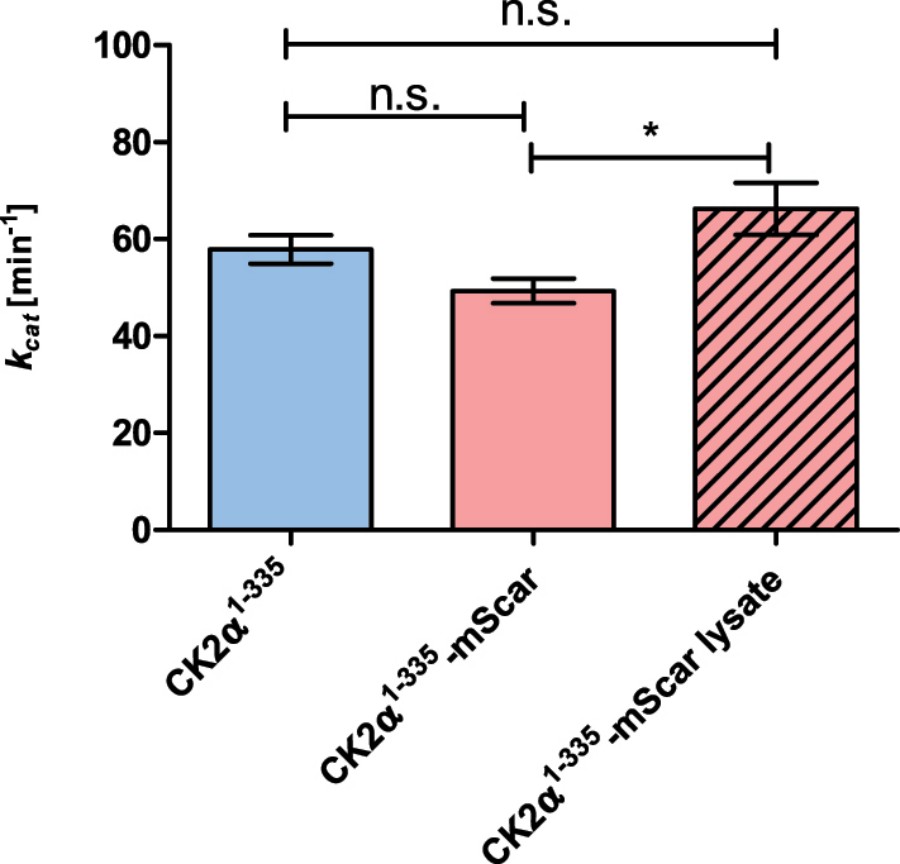 Fig. 1 Activity of purified CK2α1-335 and CK2α1-335-mScar in comparison to the activity of CK2α1-335-mScar measured in Escherichia coli cell lysates.1
While powerful, Cell Lysate Affinity Measurement presents unique technical hurdles. Cell lysates are highly complex mixtures containing thousands of proteins, lipids, nucleic acids, and small molecules. At Creative Biolabs, our expert scientists have developed robust protocols and employ cutting-edge technologies specifically designed to overcome these challenges, ensuring the generation of precise and reproducible affinity and kinetic data from your cell lysate samples.
We have curated a suite of powerful, label-free and labeled technologies to provide the most suitable solution for your specific project needs. Our platforms are optimized for high-sensitivity detection and minimal interference from the complex lysate matrix.
SPR is a gold-standard, label-free technology for real-time monitoring of molecular interactions. For Cell Lysate Affinity Measurement, we utilize a capture-based approach. The target protein is specifically pulled down from the lysate onto the sensor chip surface via a high-affinity antibody or tag (e.g., His-tag). The analyte of interest is then flowed over this captured target. This strategy isolates the interaction of interest from the bulk of the lysate, significantly reducing non-specific binding.
Similar to SPR, BLI is a label-free optical technique that measures changes in the interference pattern of light reflected from a biosensor tip. Its dip-and-read format makes it particularly robust for working with crude samples like cell lysates, as it is less susceptible to clogging than the microfluidic channels used in some SPR systems. Capture-based assays are also the standard approach for BLI analysis of lysates.
MST is a powerful, in-solution technology that measures molecular interactions by detecting changes in the movement of molecules along a microscopic temperature gradient. This movement is highly sensitive to changes in size, charge, and hydration shell upon binding. Since the measurement is performed in solution without any surface immobilization, MST is exceptionally well-suited for Cell Lysate Affinity Measurement.
ITC directly measures the heat released or absorbed during a binding event, providing a complete thermodynamic profile of the interaction (ΔH, ΔS, and stoichiometry, N) in addition to the binding affinity (KD). While ITC typically requires higher sample concentrations, making it challenging for some lysate applications, it remains the gold standard for thermodynamic characterization and can be applied to concentrated or partially purified lysate preparations.
Table 1. Technology Comparison
| Feature | Surface Plasmon Resonance (SPR) | Bio-Layer Interferometry (BLI) | MicroScale Thermophoresis (MST) | Isothermal Titration Calorimetry (ITC) |
| Principle | Refractive index change near a sensor surface | Optical layer thickness change on a biosensor tip | Temperature-induced molecular motion in solution | Heat change upon binding in solution |
| Measurement Type | Surface-based (immobilization required) | Surface-based (immobilization required) | In-solution (immobilization-free) | In-solution (immobilization-free) |
| Key Output | ka, kd, KD | ka, kd, KD | KD | KD, ΔH, ΔS, N |
| Throughput | Medium to High | High | Medium to High | Low |
| Sample Consumption | Medium | Medium | Very Low | High |
| Suitability for Lysates | Excellent (with capture methods) | Excellent (robust format) | Excellent (in-solution method) | Good (requires higher concentrations) |
We pride ourselves on a collaborative and transparent process to ensure your project's success.
Our services support a wide range of research and development applications:
To further support your research, Creative Biolabs offers a suite of Affinity Measurement related services:
Unlock a more accurate and physiologically relevant understanding of your molecular interactions. Let Creative Biolabs be your partner in advancing your research with our expert Cell Lysate Affinity Measurement services.
Q: What is the primary difference between cell lysate affinity measurement and using purified proteins?
A: The primary difference lies in the biological context. When you use purified proteins, you are studying an interaction in an isolated, artificial environment. Cell Lysate Affinity Measurement allows you to analyze the interaction within a complex mixture that mimics the protein's native cellular environment. This includes the presence of post-translational modifications (PTMs), natural binding partners, and other cellular factors that can influence the binding affinity and kinetics, providing more physiologically relevant data.
Q: My protein of interest is expressed at a very low level. Can you still measure its affinity in a cell lysate?
A: Yes. This is a common challenge that our advanced platforms are designed to address. We utilize highly sensitive technologies like Surface Plasmon Resonance (SPR) and Bio-Layer Interferometry (BLI) with specific capture-based strategies. By using a high-affinity antibody or tag to pull down your target protein onto the sensor surface, we can effectively isolate and concentrate it, allowing for accurate affinity measurement even if its concentration in the bulk lysate is very low.
Q: What types of cell lysates can you work with?
A: We can work with a wide variety of cell lysates from virtually any source, including mammalian, insect, bacterial, and yeast cells. You can provide us with your pre-prepared lysates, or our team can perform cell culture and lysis under customized, optimized conditions to ensure the stability and integrity of your target protein. We will work with you to determine the best lysis buffer composition, including the appropriate protease and phosphatase inhibitors.
Q: How do you handle non-specific binding from the complex lysate matrix?
A: Minimizing non-specific binding (NSB) is critical for obtaining high-quality data. Our strategy is multi-faceted:
Q: Which technology is best for my project?
A: The choice of technology depends on several factors, including your specific research question, the nature of your interactants, the required throughput, and your sample availability. During our initial consultation, our scientific experts will discuss your project in detail and recommend the most suitable platform:
Q: Is this service intended for clinical diagnostic purposes?
A: No. Our Cell Lysate Affinity Measurement services, like all services offered by Creative Biolabs, are for research use only (RUO). They are not intended for and should not be used for clinical diagnostic procedures.
All listed services and products are For Research Use Only. Do Not use in any diagnostic or therapeutic applications.